
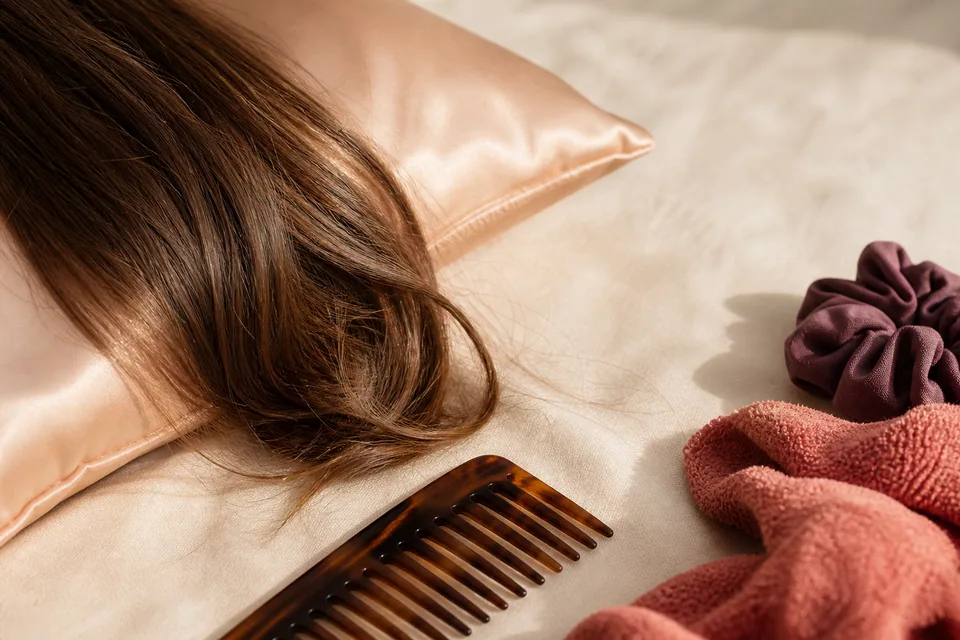
Breakage often appears as shorter snapped sections, rough lengths or many ends at different points. It may not have one isolated cause, but mechanical, thermal and chemical stress can be considered together.
Distinguish breakage from shedding
Broken hair ends along the shaft, while shed hair releases from the root. The distinction is not always obvious without close examination, especially in short or highly textured hair.
A salon can discuss visible breakage patterns and routines but cannot diagnose a medical cause. Sudden heavy shedding, bare patches or scalp symptoms should be assessed by a medical professional.
Reduce friction and tension
Detangle from the ends upward and gently support vulnerable sections. Wet hair needs particular care because vigorous rubbing, tight ties and abrupt brushing may place it under additional stress.
Repeated high-tension styles often affect the same areas. Change placement and fastening, choosing smooth suitable accessories instead of very tight or damaged ones.
Plan heat and chemistry together
Temperature, frequency and contact time affect stress from dryers, straighteners and curling tools. Heat protection supports safer handling but does not make repeated very high heat consequence-free.
Colour, lightening, smoothing and other chemical services should include the full treatment history. When elasticity and strength are clearly limited, a smaller goal or a pause may be the more sensible choice.
Use care and cutting realistically
Conditioner and targeted treatments can support detangling and feel but cannot permanently fuse split ends. A suitable cut removes weakened areas in a controlled way and creates a clearer starting point.
Do not change everything at once. Choose a few measures, observe daily behaviour and refine the routine at follow-up appointments according to actual progress.
Look carefully at the breakage pattern
Short hairs can be breakage, new growth or both
Broken hairs may appear as rough, uneven ends through the lengths, while new growth often has a tapered end and follows a pattern near the scalp. These signs are not always easy to distinguish, especially with curls or layered cuts. Avoid pulling or repeatedly testing elasticity at home.
A hairdresser can observe the cosmetic pattern and review colour, heat and handling. Sudden shedding, scalp symptoms or unexplained changes in density require medical assessment. Salon observation cannot diagnose an internal cause.
Reduce everyday friction and tension
Detangling, towels and hairstyles act on the hair every day
Support the section you are brushing and work from the ends upwards with a suitable tool. Press water out with a smooth towel rather than rubbing. Check recurring contact points such as collars, bag straps, tight elastics and the nape during sleep.
Protective styles should be comfortable and varied, not painfully tight. Repeated tension at the same hairline or attachment area can create stress. Small changes used consistently are more useful than one occasional intensive treatment while the daily cause remains.
Judge heat by temperature and contact time
Heat protectant supports the routine but is not a free pass
Use the lowest effective temperature, keep the dryer moving and reduce repeated passes with straighteners or curling tools. Allow sections to dry properly before applying tools intended for dry hair. Fine, lightened or already fragile areas may need a different setting from dense, untreated sections.
Heat protection can help reduce stress according to its instructions, but it cannot make unlimited temperature harmless. Better sectioning and root direction often shorten the styling process and reduce the need to keep correcting the same area.
Plan chemical services together
The complete history matters, not only the next appointment
Permanent colour, bleach, toners, straightening, perms and home treatments can overlap through the lengths. Tell the salon everything you remember. Processing an already weakened area again may require a reduced goal, different placement, a strand test or a pause.
Bond-supporting care may be part of a responsible colour plan but does not cancel chemical stress. A staged result can preserve more flexibility than forcing maximum change in one visit. We explain possibilities and limits before beginning.
Combine care and cutting realistically
Softness helps, but split ends remain split
Conditioner and targeted treatments can improve slip, surface feel and manageability. They cannot permanently fuse an end that has already split or replace hair that has broken away. A suitable trim removes weakened sections in a controlled way and creates a clearer starting point.
Do not change every product and technique at once. Choose a few measures, observe how the hair behaves and adjust at the next visit. Consistent handling, realistic chemical planning and an appropriate cut work together more effectively than a promise of instant repair.
Frequently asked questions
How can I recognise hair breakage?
Numerous short ends, rough sections and snapping along the length may be signs. Distinguishing it from shedding is not always simple and does not replace medical assessment.
Can a treatment repair split ends?
It may temporarily improve surface, detangling and feel. Already split or broken ends cannot be permanently joined again.
Must I stop all colour if my hair is breaking?
Not automatically. Condition, history and goal need assessment; reduced stress, another technique or a pause may sometimes be appropriate.
Can products for split ends repair them permanently?
They may temporarily smooth the surface and improve handling, but an already split end cannot be permanently fused. Cutting is the controlled way to remove it.
Must I stop all colour immediately if my hair is breaking?
Not necessarily, but the history, pattern, condition and goal must be assessed. Reduced processing, different placement, a staged plan or a pause may be more appropriate.
Continue reading in the journal
Keep reading, at your own pace.
Four selected guides that explore related questions.
-

Olaplex in the salon: what bond care can realistically do
A clear guide to using Olaplex with colour or care, setting sensible expectations and building a manageable home routine.
Read article -
Gentle blow-drying: technique, heat and shape
Salon guidance for controlled blow-drying with heat protection, clear sectioning and practical methods for smooth, fine and curly hair.
Read article -
Protecting long hair at night: care without a complicated ritual
Salon guidance on detangling, dry lengths, loose hairstyles, pillowcases and a realistic morning routine for long hair.
Read article -

Considered hair care in the salon and at home
A guide to a manageable routine, targeted product use and planned salon services without unsupported environmental claims.
Read article