
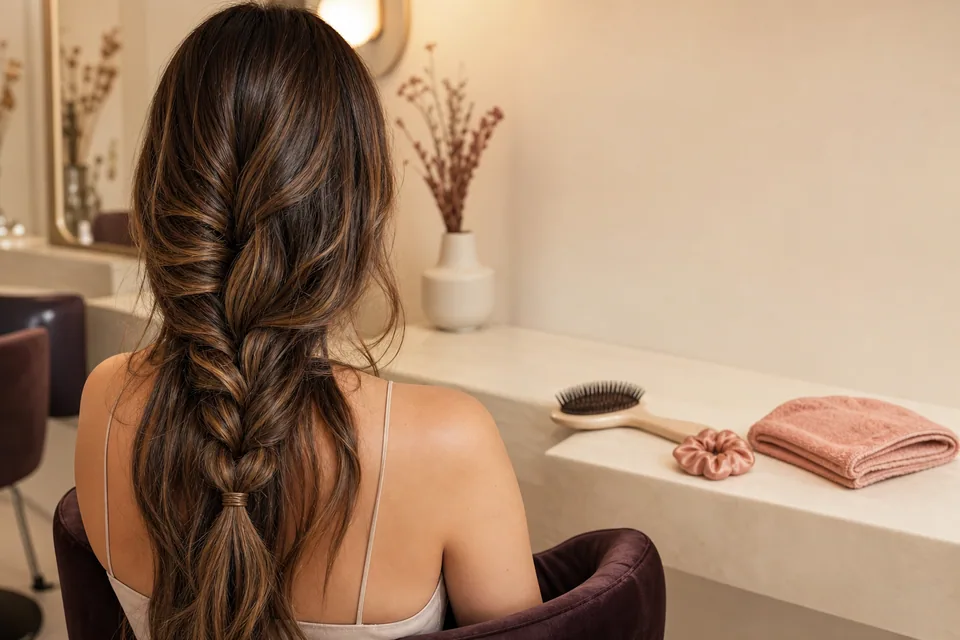
Hair extensions remain manageable when care suits the attachment system. A few consistent habits reduce avoidable tangling and help you notice changes before they become difficult.
Brush without unnecessary tension
Divide the hair into manageable sections and gently support the roots while detangling from ends upward. Use a brush recommended for the system and never pull abruptly through a knot.
The nape and areas behind the ears need particular attention because friction and movement are greater there. Feel between attachments to separate strands before small tangles develop into matting.
Wash and dry completely
Wash upright and distribute shampoo without circular rubbing through the lengths. Apply conditioner to lengths and ends according to salon advice rather than spreading it directly over attachments.
Dry the root and attachment areas thoroughly with suitable heat. Wet attachments, tightly tied hair and sleeping with damp lengths can encourage tangles and unnecessary stress.
Sleep, exercise and styling
A loose braid or another method demonstrated by the salon often helps secure the hair at night. Hair should be dry so friction and movement do not act on damp, vulnerable sections.
Exercise, swimming and strong heat require suitable preparation and care afterwards. Keep uncontrolled heat away from attachments and ask to see the safe distance and technique for your system.
Do not replace professional checks yourself
Growth changes the position of attachments and how they behave during brushing and styling. Keep the maintenance schedule agreed for the system rather than cutting, gluing or reinstalling loose strands yourself.
Contact the salon early about pulling, unusual tenderness, strong tangling or shifted attachments. Asking promptly is generally easier than addressing extensive matting later.
The first days after application
Attachment points need calm handling and clear instructions
Follow the method-specific guidance given at the fitting, including when the first wash should take place and which products should be kept away from attachment points. Avoid pulling, tight styles and experiments with unfamiliar heat. Mild awareness is normal; persistent pain, strong tension or a visible scalp reaction is not something to ignore.
Learn how to separate the rows and check that no neighbouring hairs are tangling across attachments. Do not twist or pick at a connection. Contact the salon early if something feels unusual, because a small concern is easier to assess before it becomes matted or uncomfortable.
Wash in clear sections
Clean attachment areas without vigorous rubbing
Detangle before washing and keep the hair falling in its natural direction. Distribute shampoo at the scalp in sections, using the fingertips and controlled movement rather than bunching all lengths together. Rinse thoroughly so that cleanser and residue do not remain between dense rows.
Apply conditioner or masks through the permitted lengths according to the method and product guidance. Rich or slippery products placed directly on some attachment systems can affect stability. After rinsing, press out water gently instead of twisting the hair into a towel.
Brush without pulling at the connections
Several short, calm sessions are often better than one rushed detangle
Use the recommended extension-safe brush and support the hair above the area you are working on. Begin at the ends and progress in sections toward the roots, carefully passing around attachments as instructed. Check the nape and areas behind the ears where friction and hidden tangles often develop first.
Brushing once only after severe knots have formed requires more force and can stress natural hair. Build brief checks into the morning, evening and after activities that increase tangling. Do not cut out a mat or pull a loose strand yourself; ask the salon to assess it.
Plan for heat, sport and holidays
Everyday life is possible, but it benefits from preparation
Dry the roots and attachment areas thoroughly using controlled heat and airflow. Keep hot tools away from bonds or tapes unless your individual instructions state otherwise. Heat protectant supports the exposed lengths but is not permission to use unlimited temperature or repeated passes.
Before swimming, sport, sauna or travel, choose a secure style without excessive tension and follow the method-specific advice. Rinse after pool or salt-water exposure and dry correctly. Sunscreen, oils and spa products can affect some attachments, so ask before the holiday rather than improvising on site.
Take check and refitting appointments seriously
Growth changes distance and weight distribution
As your own hair grows, attachment points move away from the scalp and can become more visible or harder to manage. The appropriate interval varies with the system, growth, density and daily care. Follow the schedule agreed at the fitting instead of waiting for a connection to cause problems.
Professional checks identify tangling, shed natural hairs held within the attachment and sections that need adjustment or removal. Refitting and removal are part of the long-term commitment and budget. Home removal can place unnecessary force on your own hair.
Frequently asked questions
How often should I brush extensions?
Regular gentle detangling matters, but the exact routine depends on the system, texture and lifestyle. Follow the technique shown during application.
Can I sleep with wet extensions?
It is best avoided. Dry attachment areas completely and secure the hair for the night as instructed.
Can I reattach a loose strand myself?
No. Keep the strand and contact the salon. Home gluing or reinstallation may place unnecessary stress on the natural hair and system.
Why should conditioner not touch every attachment point?
Some rich or slippery products can affect particular bonds or tapes. Follow the exact guidance for your method and apply care only where it is intended.
What should I do if extensions pull or hurt?
Contact the salon promptly for assessment. Do not loosen, cut or remove the attachment yourself, and seek medical help if there is a significant skin reaction.
Continue reading in the journal
Keep reading, at your own pace.
Four selected guides that explore related questions.
-
Putting extensions up: consider attachments and comfort
Putting extensions up every day? Consider loose shapes, attachment points and tension, with practical questions for your salon consultation in Klagenfurt.
Read article -

Gold Fever hair extensions: questions before selection and fitting
Gold Fever extensions in Klagenfurt: discuss your own hair, colour matching, the system and care before choosing an option with Haarstudio Style.
Read article -
Protecting long hair at night: care without a complicated ritual
Salon guidance on detangling, dry lengths, loose hairstyles, pillowcases and a realistic morning routine for long hair.
Read article -

Summer hair care: a practical guide for Klagenfurt
Keep hair cared for through sun, heat, lake and pool days with simple routines for cleansing, protection and styling.
Read article