
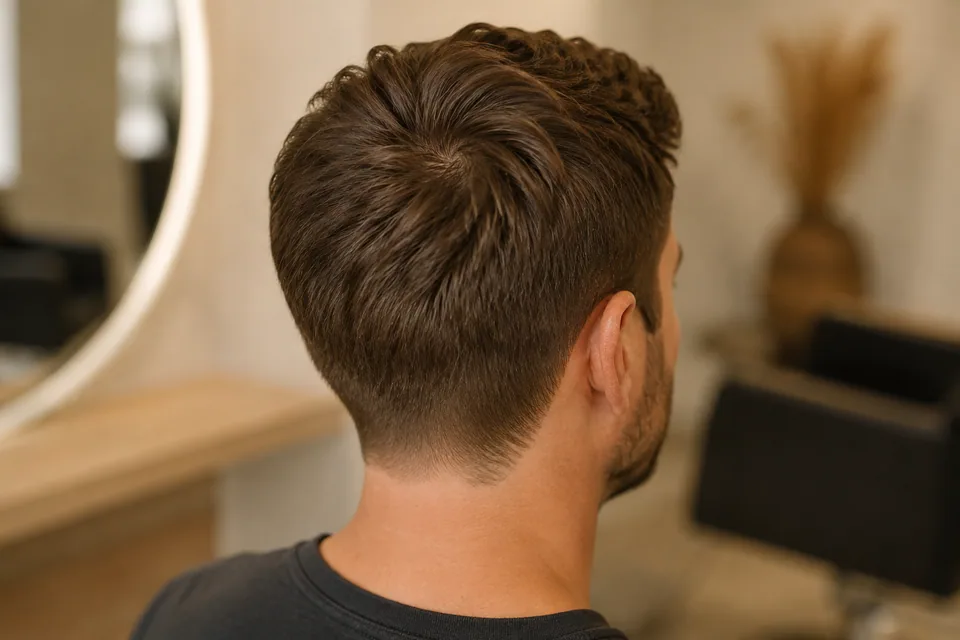
A section sticks up at the crown, the fringe opens in an unwanted place, or your parting moves back after every wash. A cowlick is not a failure of styling discipline. Hair grows in a particular arrangement there, and the cut needs to accommodate it. Instead of adding more product to fight it, consider length, weight and direction. That often explains why a seemingly small cutting decision makes such a difference in everyday life.
Show the difficult area before cutting begins
Arrive with the hairstyle you normally wear where possible, and explain what happens after washing it yourself. A strongly fixed salon or product finish can conceal where the hair naturally separates. Point out the spot: is it the centre of the crown, an adjacent edge or the front hairline? This distinction is more useful than a general request to make the cowlick disappear at your next cut.
The situation matters too. Does the area always stand up, or only after sleep? Is it flattened under a cap and then springing differently afterwards? A photograph from an ordinary morning can help if the issue is not visible on appointment day. You do not need perfectly lit images. The point is growth and everyday behaviour, not a polished result. A specific observation gives the consultation a useful starting point.
Shorter can help—or make the area more obvious
A short cut removes length but does not change the direction in which hair grows from the scalp. Shortening a previously weighted section may make it stand up more. A deliberately close overall shape, however, may work well with that direction. Between those extremes, certain lengths can behave particularly independently. “Just make it shorter there” is therefore not automatically the best correction for every cowlick.
Ask whether the area would benefit from retained weight or from a consistently short approach. Both may be sensible, but they suit different overall styles. The transition into neighbouring areas matters as well. A single heavily shortened patch can look less settled than the original movement. Assess the intended shape from the back and side, not only from the front in a mirror.
Try the parting around the natural opening
A parting against the preferred growth direction may require styling that a reference photograph does not reveal. That does not make the idea impossible, but it should be understood beforehand. Try a slightly different position during the consultation. Sometimes a modest shift changes how neatly the front falls. What matters is whether you like the effect and can recreate the direction with a manageable step.
If you want part of your forehead covered, show how the hair naturally lies forwards without tension. A strong front cowlick may open a compact fringe edge differently from what you expect. A side-swept style or one with more movement may then suit you better than trying to prevent every separation. Face shape and trend names need not be the only criteria. Working with the natural division can make the hairstyle much easier to wear.
Organise the important section first when drying
If you blow-dry, address the difficult area before it dries completely in an awkward direction. The precise brushing or finger movement should suit the growth pattern and haircut. Ask to be shown the sequence at your appointment. A repeatable movement with controlled warmth is more useful than hurriedly directing air against it from several angles. You are supporting the chosen shape, not trying to force hair into obedience with maximum temperature.
You can find further principles in our guide to gentle blow-drying with suitable airflow. Start the finish with little product and assess the dry shape first. Wax, paste or gel can change hold and surface, but cannot remedy an unsuitable length. If a large amount is needed to control just one spot, that is useful feedback for the next discussion about your cut.
Do not mistake sleep or headwear effects for a cutting problem
Even a well-planned haircut can lie differently after a night’s sleep. A flattened section may need only a little water and a targeted restart. That differs from an area that springs in the same unhelpful direction immediately after every wash. Observe the distinction. Looking only at the result after sleeping may lead you to request a cutting correction when a temporary shape mainly needs resetting.
Mention work headwear or a helmet you use in daily life during the consultation. The hairstyle needs to accommodate those requirements; a safe fit should not be altered for the sake of hair volume. Instead, discuss an outline that can be arranged quickly after removal. A short, understandable routine is usually more realistic than a carefully built style that loses its entire shape whenever anything touches it.
Plan the next haircut around how the shape develops
A cowlick may become easier or harder to manage with a little growth. It is therefore worth observing the weeks after a new cut. When does the section fall best? At what length does it change? These details support a more targeted next adjustment than asking for the same length everywhere. Different areas can have different roles, provided the overall shape works together.
At Haarstudio Style in Klagenfurt, you can raise your cowlick as a specific consultation topic. Bring your observation and, if useful, an everyday photograph rather than making a completely smooth reference the only goal. A sensible approach also considers whether you want to blow-dry and which outlines matter to you. The result need not hide every natural change in direction. Above all, it should be clearly planned and wearable with your normal routine.
Frequently asked questions
Can a hairdresser cut a cowlick away?
Cutting does not remove the natural growth direction. Suitable length and shape can alter its effect, however. Whether retained weight or a consistently short approach makes sense depends on the area and the overall hairstyle you want.
Will stronger gel control every section that sticks up?
No. More hold can change the finish but cannot replace suitable cutting decisions. If one area constantly needs a great deal of product, consider its length, parting and drying method. A heavy product may weigh down other sections as well.
Must my parting follow the natural division exactly?
Not necessarily. Another position may be possible but could require more styling. Try small changes and see which works without constant correction. The right decision also depends on the morning routine you want.
Continue reading in the journal
Keep reading, at your own pace.
Four selected guides that explore related questions.
-

Choosing a men’s haircut: contours, texture and transitions
Which contours and transitions suit your haircut? Understand growth patterns, scissors, clippers and styling before a consultation in Klagenfurt.
Read article -
Beard and haircut: plan the outlines as one complete look
Consider beard lines, sideburns and haircut together: proportions, everyday care and clear wishes for your consultation at Haarstudio Style in Klagenfurt.
Read article -
The pixie cut: short hair that fits your everyday life
Planning a pixie in Klagenfurt? Explore the outline, top length and styling routine that suit you before taking the step towards a short haircut.
Read article -

How to use styling products: hold, volume and shine without overload
A practical salon guide to mousse, gel, cream, wax, spray, powder, oil and a clear sequence for different finishes.
Read article