
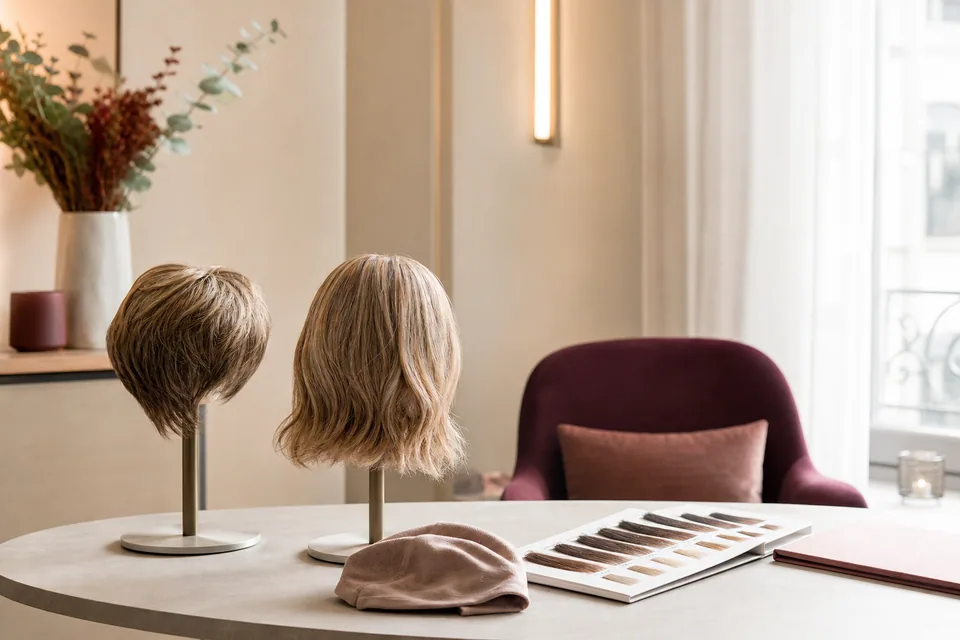
A wig may be chosen for fashion, practicality or deeply personal reasons. Good consultation leaves room for questions, respects privacy and makes no assumptions about health or circumstances.
Begin the appointment with your needs
When booking, say whether you would prefer privacy, a companion or additional time. You do not need to explain a personal history in order to receive respectful and discreet advice.
Desired length, colour, daily routine and the date by which the wig may be needed are useful details. They help the salon prepare relevant questions and options.
Understand material and construction
Synthetic fibres and human hair differ in behaviour, care, styling options and required effort. Neither is universally right; priorities, dexterity and desired flexibility should guide the comparison.
Cap construction, hairline and parting design also affect comfort and appearance. Ask to see differences calmly and try the movements you expect in daily life.
Personalise fit and style
A wig should feel secure without creating uncomfortable pressure. Circumference, position, hairline and possible adjustments are checked together, and persistent pressure points should not be ignored.
Cutting and styling can bring a model closer to your face, glasses and personal expression. Changes should be made gradually because removed length cannot be restored.
Learn care and storage
Washing, drying, detangling and heat tolerance depend on the material and manufacturer guidance. Do not automatically use normal hair products; ask for suitable formulas and techniques.
Clean, dry storage helps protect shape and fibre. Also ask which small adjustments are safe at home and when a professional review would be useful.
Clarify the occasion and wearing situation
Daily use, a temporary phase and occasional wear have different needs
Think about how many hours the wig will be worn, whether you travel, work in heat, exercise or combine it with headwear. A model for everyday use may prioritise comfort, simple care and a dependable familiar shape, while occasional use may allow different styling priorities.
Tell us whether your own hair is changing and whether the wig needs to fit over it now and later. Medical details only need to be shared when they affect fit, skin tolerance or handling. A salon consultation does not diagnose the reason for hair loss.
Compare synthetic and human hair objectively
Material choice is a trade-off, not a ranking
Synthetic models often retain their manufactured shape and may require less daily styling, while heat and product options depend strictly on the fibre and instructions. Human-hair models can offer different styling possibilities but generally need more active washing, drying and shaping.
Quality, construction and personal needs matter within both categories. Price alone does not tell you which model will be comfortable and practical. We explain the characteristics of the available selection and relate them to your routine rather than calling one material universally better.
Test fit and fastening
Security should not come from uncomfortable pressure
The cap should sit stably without creating painful pressure points. Check the hairline, ears, nape and movement when turning or bending the head. Adjusters and possible fastening options are considered according to the model, your scalp and any natural hair present.
Wear the model long enough during the fitting to notice warmth or tension, and tell us immediately if something feels wrong. A secure fit remains individual and may change if the amount of natural hair changes. Follow-up adjustment can therefore be part of the plan.
Personalise cut and colour
Small adaptations can change the overall impression significantly
Where the construction allows, the outline, fringe and volume can be adapted to the face and preferred style. We agree any cutting carefully because removed length cannot simply be restored. Photographs of a familiar previous hairstyle may help define the intended result.
Colour changes are limited by material and manufacturer instructions. Many synthetic fibres cannot be coloured like natural hair, and even human hair requires a specific assessment. Choose the closest suitable base and discuss any permitted adjustment before purchase.
Clean, dry and store correctly
The manufacturer’s instructions remain the primary guide
Use products and water temperature suitable for the exact material. Avoid rubbing, twisting or ordinary hot-tool techniques unless they are explicitly permitted. Dry the model in the recommended position and do not brush or reshape it in a way that conflicts with the fibre instructions.
Store it clean, dry and protected from friction, direct heat and distortion. The useful cleaning frequency depends on wear, scalp contact, climate and products. Good care supports appearance and service life but cannot create a fixed durability guarantee.
Try and decide without pressure
You may consider several everyday situations before purchasing
Bring a trusted person if that helps, but the final choice should feel right to the wearer. Look at the model from all angles and in ordinary light, with the glasses, clothing colours or headwear you often use. Move naturally rather than judging only a still mirror pose.
Ask about availability, ordering, adjustment, care supplies and any exchange conditions before committing. Insurance reimbursement differs by provider, prescription and individual case; clarify current requirements directly with the responsible insurer and bring the necessary documents.
Frequently asked questions
Do I need to explain why I want a wig?
No. You choose which personal information to share. The selection mainly needs your preferred look, wearing routine, fit and care requirements.
May I bring someone with me?
This can usually be arranged when booking. Mention it in advance so the salon can prepare a calm setting.
Which is better: human hair or synthetic fibre?
They have different characteristics. Styling preferences, care time, wearing frequency and personal comfort matter more than a universal ranking.
Is human hair always better than synthetic fibre?
No. The appropriate material depends on comfort, styling expectations, care time, budget and the specific model. Each has advantages and limits.
Can every wig be changed to a different colour?
No. Colouring depends on the material, construction and manufacturer guidance. Many synthetic wigs cannot be coloured like natural hair, and human hair still needs professional assessment.
Continue reading in the journal
Keep reading, at your own pace.
Four selected guides that explore related questions.
-

Everyday life with a wig: try glasses, clothing and comfort
A wig should work with glasses, collars and daily activities too. Prepare for the fitting and explore its comfort, handling and specific care needs.
Read article -
Haarstudio Style in Klagenfurt: what useful advice should cover
What to discuss at Haarstudio Style in Klagenfurt: hair goals, limitations, services and everyday care. Clear consultation without sweeping promises.
Read article -
Scalp care: a calm foundation for well-kept hair
A respectful guide to cleansing, styling residue and knowing when salon advice or medical assessment is appropriate.
Read article -
Fine hair: creating visible fullness through shape and routine
Practical guidance on cutting, styling and caring for fine hair without exaggerated volume promises.
Read article