
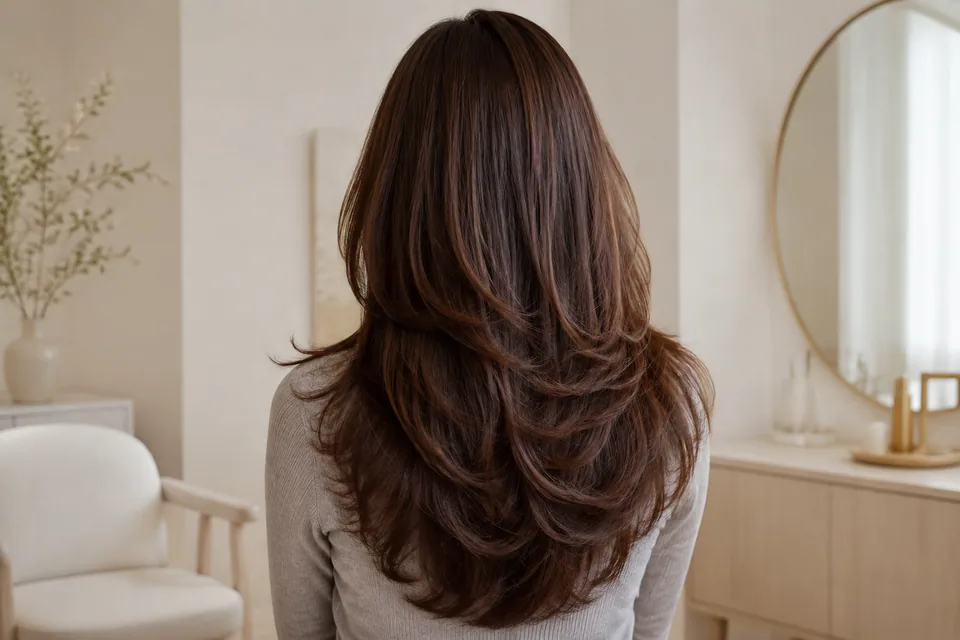
Long hair can look heavy even when its ends are fine. It may have plenty of movement yet still fall awkwardly around your face. Layers aim to address those differences selectively. The question is not simply “layers or no layers?” but where weight should remain, where it can be reduced and which sections must still reach a ponytail. Those details provide a much stronger basis for a suitable haircut.
Identify where the hairstyle actually feels heavy
Look at your loose hair from the front, side and back. Is most of its mass at the bottom, is movement missing around your face, or does the crown lie flat? These observations describe different wishes. Layers redistribute lengths; they do not create additional hairs. If the ends already look very transparent, removing more material from the perimeter should not be the automatic response.
Point out the specific area during your consultation instead of simply asking for “more volume”. For example: “I like the length, but the front always pulls down when I blow-dry.” Or: “I still want the ends to look solid from behind.” A small outline adjustment may be the answer, rather than strong layers throughout the whole head. That keeps the change focused on what you actually need.
The perimeter and the layers do different jobs
The perimeter defines the outer edge of your hairstyle. Shorter sections above it influence how movement, weight and transitions are perceived. These should be planned together. A full lower outline can combine with restrained layers, while more pronounced layering creates a deliberately lighter impression. Neither option is automatically more modern or better quality. What matters is the effect that suits your density, texture and preferred way of wearing your hair.
Ask to be shown the shortest section being proposed. This often makes the scale of the change clearer. The difference between shorter and longer areas matters too: a noticeable step looks different from a flowing transition. If keeping length is your priority, discuss it explicitly. “Just a few layers” says little about how much will actually change, or which areas will be affected.
Discuss the face-framing sections separately
Front layers can frame your face differently without changing the back to the same extent. The shortest strand and your usual parting are important here. A contour that falls softly with a centre parting may behave differently with a pronounced side parting. Sit naturally during the consultation and demonstrate how you push your hair back during the day. Those movements reveal a great deal about a practical length.
If you need to gather all your hair for work, sport or meals, mention this before the cut. Very short front sections may no longer reach your ponytail. That can be intentional, but it requires a different routine with clips or a headband. Glasses wearers should also consider the area around the arms. A good transition should not need constant repositioning between your face, glasses and ears.
Assess curls, straight hair and blow-dried waves differently
Layers in smoothly blow-dried hair display lengths differently from the same idea in natural waves. A shorter curly section may spring up more, while a transition can be more visible in very straight hair. Describe the texture you wear most often. A reference with carefully styled waves does not demonstrate that the same movement will appear without styling. Recognising that distinction can prevent disappointment in front of the bathroom mirror.
Mixed textures within the same head are relevant too. Your front may be straighter while the nape is more wavy. Rather than demanding identical lengths everywhere, discuss the overall effect you want. The consultation should also establish how much blow-drying you intend to do. Layers can support movement, but they replace neither suitable drying techniques nor the natural characteristics of your hair.
The cut should work with the routine you already have
Before your appointment, consider which tools you genuinely use regularly. A large round brush, a diffuser and air-drying produce different results. If you want a pronounced outward movement at the front, a particular styling step may be necessary. Ask to see it before choosing a shape that depends on it. An everyday haircut should not rely on hoping that you will suddenly enjoy an entirely different routine tomorrow.
Our guide to gentle blow-drying for longer and shorter sections can help with the finish. Work in manageable areas and avoid unnecessary repetition on ends that are already dry. After a cut, first get to know the new shape with little product. Several heavy layers of conditioner and styling products can conceal precisely the movement that the haircut was intended to reveal.
Keeping length means limiting changes deliberately
If you want to retain long hair, agree clearly on the extent of the cut. Show where your current length ends and how much loss would be acceptable. This includes an honest assessment of the tips: a small adjustment may suffice, whereas very uneven ends call for a different decision. You do not have to take every available option at once. A restrained first change can reveal whether you want extra movement throughout the hair at all.
After a few washes, note which areas work better and which need attention. Do the front strands fall comfortably, does your ponytail remain practical, and does the perimeter look as full as you wanted? Those specific observations are more useful at the next appointment than “a few more layers”. You can discuss these priorities at Haarstudio Style in Klagenfurt. The aim is an understandable shape that brings length, movement and everyday needs together.
Frequently asked questions
Are layers useful for fine, long hair?
They can be, but they must suit the amount of hair available. Removing too much from the lengths may make the ends look less solid. Gentle face-framing or targeted shaping may therefore be preferable to strong layers throughout.
Do layers automatically create more curls?
No. Shorter sections can change how existing waves or curls fall, but they do not fundamentally alter your natural texture. How much a section springs up depends on factors including its texture, length and previous treatment.
Can I still wear a ponytail with layers?
That depends on the shortest section and the ponytail’s position. Demonstrate your usual style before cutting begins. You can then discuss which strands need to stay long enough and whether some shorter face-framing pieces would be practical for you.
Continue reading in the journal
Keep reading, at your own pace.
Four selected guides that explore related questions.
-
Protecting long hair at night: care without a complicated ritual
Salon guidance on detangling, dry lengths, loose hairstyles, pillowcases and a realistic morning routine for long hair.
Read article -
Gentle blow-drying: technique, heat and shape
Salon guidance for controlled blow-drying with heat protection, clear sectioning and practical methods for smooth, fine and curly hair.
Read article -

Fine hair: creating visible fullness through shape and routine
Practical guidance on cutting, styling and caring for fine hair without exaggerated volume promises.
Read article -

Curtain bangs in Klagenfurt: cutting, styling and growing out
How to adapt curtain bangs to texture, parting and daily life, including styling, care and sensible trim planning.
Read article