
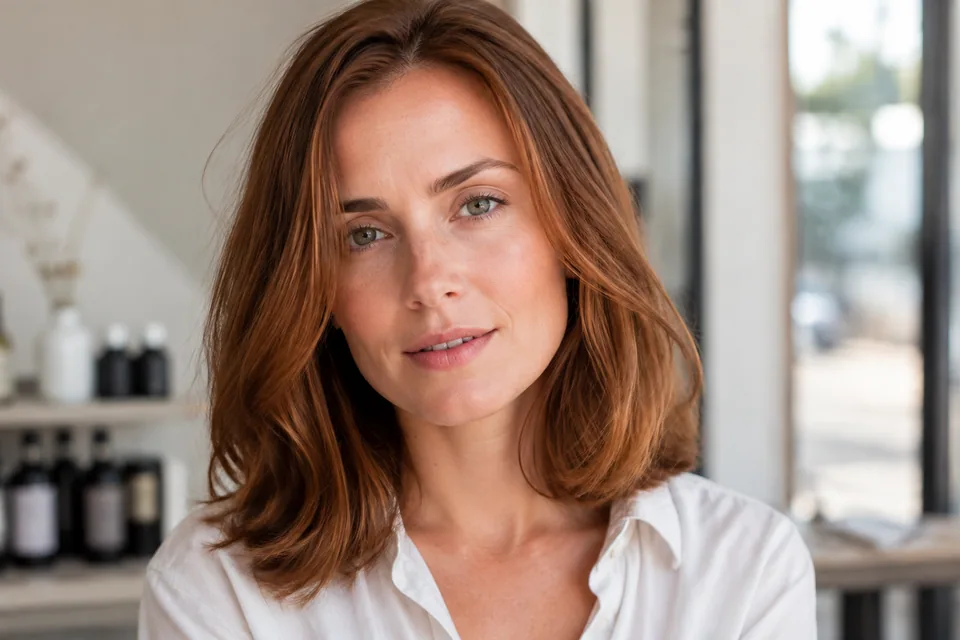
A new hair colour changes how your face is framed. You may then wonder whether to emphasise your lashes or eyebrows differently too. No automatic adjustment is necessary: naturally darker brows can suit light hair, and subtle lashes can be as deliberate a choice as stronger contrast. What matters is a coherent look you feel comfortable wearing without elaborate daily make-up.
Not everything needs to be the same shade
Hair, brows and lashes play different visual roles around the face. An exact colour match is therefore not a useful universal goal. Brows frame your expression, while lashes can emphasise the eye area. The intensity that feels comfortable also depends on your own perception of contrast and the make-up routine you are used to.
Do not judge one feature only from very close up. Look at your face from a normal conversational distance in even light. A brow colour can seem much stronger directly in front of a mirror than within the overall appearance. Conversely, a shade you like on a small colour sample may look different beside your new hair colour.
Start with the amount of contrast you want
Consider whether you want barely noticeable emphasis or a clearer outline. Descriptions such as “a little more visible, but not as if drawn on” help a consultation. If useful, bring a photograph showing your usual make-up effect. It communicates the intensity you find familiar without already assuming that a particular tinting technique is needed.
After a substantial hair colour change, it is worth reconsidering the overall contrast. Moving from very light to dark hair, or back again, can change your perception. Several treatments need not happen on the same day, though. You may prefer to get used to the new hair colour in everyday life before deciding on any additional emphasis.
Understand what tint changes—and what it does not
Tinting changes the colour of the lashes or brow hairs already present. Previously very pale hairs may become more visible. It does not create additional hairs or allow the actual shape and density to be changed without limit. A densely defined appearance in a photograph may also involve make-up, lighting or image editing rather than colour alone.
Distinguish “more contrast”, “a different shape” and “more fullness”. These describe different wishes. Explain which one concerns you instead of combining every expectation under “brow tinting”. The discussion can then establish the effect the offered service may achieve and which parts of your desired result do not automatically follow from changing the colour.
Decide on lashes and brows separately
A suitable brow shade does not necessarily determine the lash shade. You can emphasise the brows softly and the lashes more clearly, or choose just one service. Consider your usual lash, brow and eye make-up routine. Someone who regularly wears bold glasses, for example, experiences the surrounding frame differently from someone without glasses.
Our overview of lashes, eyebrows and make-up helps distinguish the available components. Ask if you expect another cosmetic treatment as well. Offering a tinting service does not mean that every technique shown on social media is also included. Establishing the actual service is more useful than relying on a broad label or an unfamiliar trend name.
Discuss precautions beforehand
Products intended for the eye area and their current application instructions are what matter. A colour designed for scalp hair is not suitable for lashes or brows merely because the shade looks right. Do not use such products for an unintended purpose yourself. Mixing, processing time and protecting the eye area do not belong in a general do-it-yourself guide.
Mention known reactions to colourants or cosmetics before an application. Ask early about product-specific precautions and any preparation, which may require additional lead time. Having tolerated a previous application is not a general safety guarantee. If skin is currently irritated or there are eye symptoms, first clarify whether the treatment should take place at all.
Prepare without avoidable surprises
If you wear contact lenses, mention this beforehand and ask what is planned for the particular application. Existing eye make-up and other recent treatments around the eyes are also practical preparation details. The aim is not to write down as much personal information as possible, but to coordinate the application sensibly and without unnecessary time pressure.
Mention an additional service when requesting your appointment. Hair colour processing time is not automatically a free appointment for other work. Planning establishes whether the combination makes sense. Before an important occasion, also leave room to discuss the desired appearance, rather than deciding on the intensity immediately before you need to be ready.
Assess the result in your everyday life
After the application, consider the overall effect without expecting every individual hair to look identical. Brows are not naturally perfectly symmetrical. Harmony comes from the interaction of shape, distribution and intensity. Compare the result with the goal you discussed, not with heavily edited close-up photographs that may show a different kind of finish altogether.
Ask for aftercare guidance appropriate to the application actually used. How long a colour effect remains visible cannot be promised identically for everyone. If helpful, note whether the intensity felt comfortable in everyday life. That feedback makes the next conversation more useful than simply asking for exactly the same thing without describing how you experienced it.
Use a simple decision aid for the consultation
If you usually wear little make-up, your goal may be a subtle emphasis of existing hairs. If you regularly pencil the brows in, you may be interested in a more defined starting appearance. After a major hair colour change, discussing contrast without immediately changing anything can also be sensible. None of these options is automatically right for everybody.
At Haarstudio Style in Klagenfurt, these details can be discussed alongside your overall look and preferences. Bring your glasses and a realistic example of the effect you normally wear. A good decision need not change as much as possible. It is often more important to explain how strong the emphasis may be and which areas should remain unchanged.
Frequently asked questions
Must eyebrows match hair colour exactly?
No. Different shades can create a coherent overall appearance. Discuss contrast, desired intensity and everyday wear above all. An exact match is not a general rule.
Does brow tint automatically replace all my make-up?
Not necessarily. Tint emphasises existing hairs. How much additional definition you want afterwards depends on your own goal; a different density or an entirely new shape is not automatically created by colour.
Continue reading in the journal
Keep reading, at your own pace.
Four selected guides that explore related questions.
-
Hair with glasses: plan your fringe, sides and frames together
Which hairstyle works with your glasses? Coordinate the fringe, sides and frame arms through practical checks and individual haircut advice in Klagenfurt.
Read article -
Hair-colour consultation: from desired shade to a realistic plan
A salon guide to reference images, colour history, brightness, reflection, tests, care and transparent stages for a new hair colour.
Read article -
Hair for a job application photograph: polished and recognisable
Natural styling for job application and business portraits: plan your shape, face-framing sections and preparation without becoming someone else on camera.
Read article -
Root colour or highlights: which colour plan suits you?
Blend roots, add lighter accents or blend grey naturally: choose a colour plan that suits your hair, preferred contrast and everyday life in Klagenfurt.
Read article