
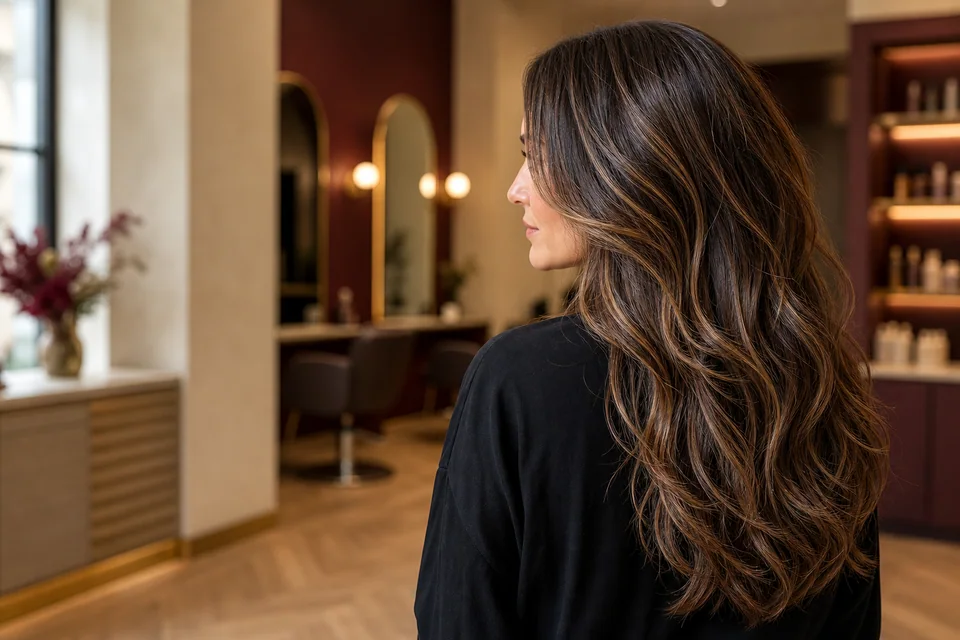
A good colour consultation translates a picture or shade name into a realistic route for the actual hair. Natural roots, old pigment, lightness, structure and care habits determine what makes sense in one appointment. This guide explains the most important questions without guaranteeing a particular result or fixed longevity.
Describe the goal more precisely than a colour name
Brightness, reflection and placement are separate decisions
“Blonde”, “brown” or “copper” does not tell us how light, cool, warm, uniform or dimensional the result should be. Explain whether the priority is brightness around the face, softer regrowth, greater depth, reduced warmth or complete coverage. These details lead to different techniques.
A shade name also looks different on screens and in changing light. We separate the lightness level from the reflection and decide where colour should be placed. This creates a clearer shared goal before formulas or appointment times are discussed.
Choose references with explained details
Three clear pictures are more helpful than thirty contradictory ones
Select a small number of images and name exactly what you like in each: perhaps the root transition, amount of contrast, tone or face frame. Include more than one angle where the cut or placement matters. Avoid heavily filtered images when colour is the main concern.
References are a visual language, not a guarantee. The photographed person may have different density, extensions, lighting and styling. We translate useful elements to your hair rather than promising an identical copy.
Disclose the complete colour history
Pigment remains in the lengths longer than it remains in memory
Mention permanent colour, toners, direct dye, plant-based products, bleach, home kits and chemical straightening with approximate dates. Even if the roots are now natural, treated sections can remain through the lengths and respond differently.
If you do not know the exact product, say what you remember. Hidden or uncertain pigment can affect lift, warmth and evenness. A strand test may provide useful guidance, but it cannot guarantee the response of every section.
Choose technique around regrowth and appointment rhythm
The most attractive colour must also work between salon visits
A solid root colour, highlights, balayage, gloss or blend of natural grey each develops differently as hair grows and toner fades. Tell us how often you realistically want to return and how much contrast you are comfortable seeing.
Retaining natural depth or using softer placement can create a gentler transition, while a precise high-contrast result may need more regular maintenance. The technique should support your lifestyle, not only the first photograph.
Assess feasibility and stages honestly
A responsible first step may differ from the final image
Old dark pigment, uneven porosity or fragile lengths can limit what should be attempted in one visit. Lightening reveals underlying warmth, and removing artificial colour is not a simple reversal. We explain a safe first target and how it leads towards the broader goal.
A staged plan is not a guarantee that the final picture can be reproduced exactly. Hair condition is reassessed each time. Sometimes the better decision is to retain more depth, cut weakened ends or pause before the next chemical service.
Discuss care and colour development in advance
The desired reflection changes with washing
Toners and glosses evolve according to washing frequency, water, sunlight, porosity and home products. A cool or beige reflection may soften and reveal more underlying warmth. No honest plan promises an identical tone indefinitely.
We explain gentle cleansing, conditioning, heat protection and any pigmented product suitable for the chosen result. Strong home toners can take unevenly on porous areas, so more pigment is not automatically better.
Record time and cost transparently
The proposed scope should be as clear as possible before starting
Price depends on length, density, colour history, materials, tests, technical stages and finishing. A photograph cannot show all of these factors. The consultation provides a more useful guide range and clarifies whether the first appointment is for testing, a complete service or one stage.
We agree the intended work and do not add unplanned steps without discussion. Ask what future refreshes may involve too, because the complete maintenance plan matters as much as the initial colour.
Frequently asked questions
Why is one photograph not enough for an exact price?
A picture cannot show density, full colour history, porosity, hidden pigment, required materials or processing time. These are assessed during the consultation.
What is the difference between brightness and reflection?
Brightness describes the lightness level; reflection describes whether that level appears cool, neutral, beige, golden, copper or another tonal direction.
Must a major colour change take several appointments?
Sometimes. Old pigment, hair condition and the amount of change may make a staged route more responsible. The starting point determines the recommendation.
Can a salon guarantee the exact shade?
No responsible salon can guarantee an identical result or fixed longevity for every hair. A clear plan improves predictability while recognising individual response.
Continue reading in the journal
Keep reading, at your own pace.
Four selected guides that explore related questions.
-

Colour correction in Klagenfurt: rebuilding colour with control
An honest guide to colour history, strand testing, staged work and care during professional colour correction.
Read article -

Root colour or highlights: which colour plan suits you?
Blend roots, add lighter accents or blend grey naturally: choose a colour plan that suits your hair, preferred contrast and everyday life in Klagenfurt.
Read article -

Tinting lashes and eyebrows: coordinate the overall look
How do lashes, eyebrows and hair colour work together? Explore contrast, natural-looking definition and a thoughtful consultation at Haarstudio Style.
Read article -

Wearing grey hair with modern confidence: transition, cut and care
A judgement-free guide to naturally grey hair, covering transition strategies, cuts, tone care and practical styling.
Read article