
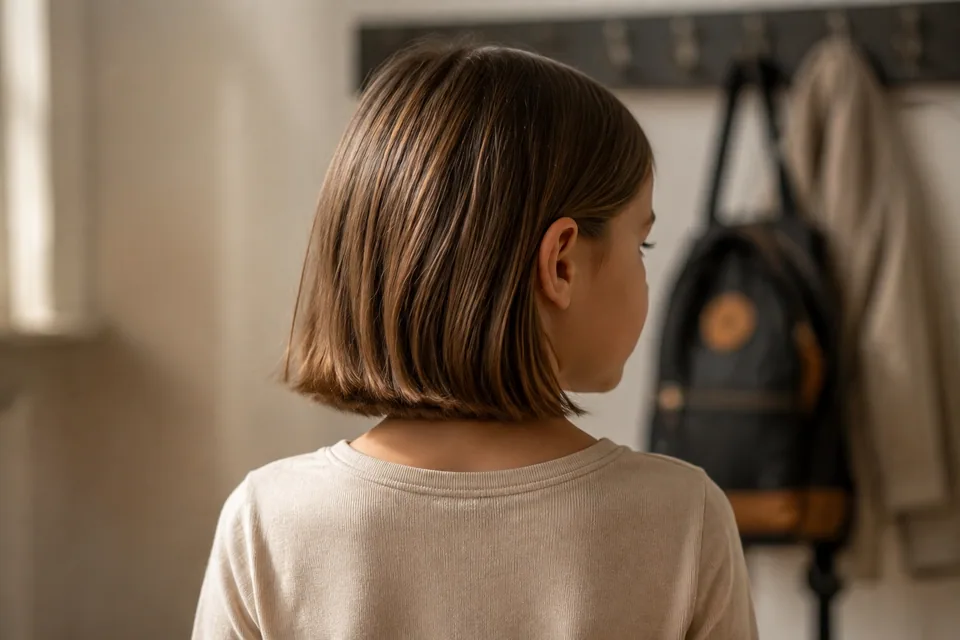
A successful school hairstyle is not judged only by the class photograph. It can be arranged without a morning argument, gets in the way as little as possible during writing, and suits playtime and sport. There is no single correct children’s cut: what matters is which parts your child can already manage independently and where support is still needed.
Consider the school day from your child’s perspective
Ask specifically what bothers them about the current hairstyle. Does hair fall forwards while drawing? Does a clip press under a cycling helmet? Does detangling take too long? These situations are more useful than a general demand for “tidy” hair. A child can often identify an annoying section even without knowing how to describe a different haircut.
Discuss what should stay as well. A longer front section may feel particularly important, or a ponytail may be part of their familiar appearance. These preferences need not immediately be set against practical concerns. It may be possible to retain the style’s character while changing the particular area that is difficult to manage during the day.
Choose length around abilities, not stereotypes
Short hair is not automatically simple, nor long hair automatically difficult. A short cut may need arranging again each morning. A longer shape might be easy to tie back but require careful detangling. Consider which movements your child already manages and how much help is actually available within the daily routine, rather than judging only by length.
Try the proposed routine before making a major change. Can your child remove and replace a hair tie independently? Is there a brush they are comfortable using? Will enough length remain to move hair away from the face when necessary? These small questions help more than rigidly assigning particular styles to girls or boys.
Plan the fringe and face-framing areas carefully
A fringe can be an intentional part of the style, but should suit growth direction and daily activities. Show how the front normally falls. Hair pulled artificially straight gives a different impression from its natural movement after washing. With curls and cowlicks especially, that starting point matters when deciding on a length the child can comfortably wear.
Let your child look down in the mirror, turn their head and move the hair aside themselves. This reveals which section might interfere with schoolwork. An alternative to a very short fringe could be another direction or enough length to pull it back. The sensible solution depends on the actual shape, not a general school hairstyle trend.
Include sport, helmets and school requirements
Ask the school about its requirements for hair and jewellery during physical education or particular activities. Do not assume every clip can be worn everywhere. Straightforward arrangements are helpful when your child understands them and can adjust them without many separate pieces. A hairstyle should support participation in the day, not depend on constant adult intervention.
When cycling, the helmet must still fit in its intended position. A large hair fastening must not displace it. Discuss the hairstyle alongside the actual helmet and its instructions. Hair is adapted to safe use, not the other way round. Planning a school haircut includes these journeys and activities rather than considering only how it looks while sitting still.
Keep the morning routine short and understandable
A useful routine consists of a few steps repeated in the same order: gently detangle, arrange the relevant section, then tie back if needed, for example. Keep suitable tools within your child’s reach. Elaborate daily styling is not usually a sensible foundation for a school hairstyle. The routine should be possible on an ordinary morning, not only when everyone has extra time.
Demonstrate a movement slowly and let your child try it afterwards. A result that differs from adult styling is not automatically a problem. Comfort, manageability and a clear view during the relevant activity matter most. A cut that looks right only with extensive help may not yet fit the degree of independence you are trying to encourage.
Detangle without unnecessary pulling
Take a calm approach to tangled sections. Work gently in manageable areas instead of dragging a brush from the roots through every knot. Suitable care and tools depend on texture and length. Ask for a demonstration on your child’s own hair so that the method is understandable and comfortable, rather than following a technique that suits a different texture.
Ponytails and plaits need not be painfully tight either. If an area pulls, loosen or rearrange the fastening. Your child should be able to mention discomfort without having it dismissed as unwillingness. A comfortable hairstyle and calm routine are more useful long term than expecting every individual strand to remain firmly in place throughout the school day.
Make the salon visit a shared conversation
Our children’s hairstyles focus on a suitable shape and respectful treatment of the child. Explain briefly beforehand what the visit will involve. Show a possible length change clearly and leave room for questions. A surprising major alteration is not a sound basis for trust. Understanding the plan helps your child take part in the conversation.
Bring one or two realistic photographs instead of a large collection of very different styles. Identify the appealing feature: exposed ears, a particular fringe or enough length for a ponytail. Discuss the decision on the hair actually present. A photograph showing a very different texture need not be copied exactly in order to find a suitable haircut.
Recognise when a trim becomes useful
A fixed number of weeks does not suit every child or shape. Observe whether the hairstyle is losing its practical function. Does a section constantly need pushing out of the eyes? Are particular ends becoming harder to detangle? Does your child want to try another length? Such changes provide a useful reason to discuss the next cut.
After the visit, note which steps work well and where help is still needed. The next appointment at Haarstudio Style in Klagenfurt can build on those observations. A school hairstyle can develop with the child’s texture, taste and abilities. It need not stay permanently unchanged, nor follow every new trend as soon as it appears.
Frequently asked questions
Is short hair always more practical for school?
Not always. Texture, growth direction and your child’s abilities matter. Some longer shapes are easy to tie back, whereas a short cut may need rearranging every day.
How often should a school-age child have a trim?
Use the chosen shape and its everyday usefulness as a guide. If clear vision, manageability or the desired outline no longer works, discuss an adjustment. One fixed interval for every child would be too general.
Continue reading in the journal
Keep reading, at your own pace.
Four selected guides that explore related questions.
-
A child’s first haircut: calm, age-appropriate preparation
A respectful guide for parents covering timing, language, breaks and realistic expectations for a first salon visit.
Read article -
How to wash your hair properly: a routine for scalp and lengths
Detailed salon guidance on wash frequency, shampoo, conditioner, rinsing, drying and keeping your product selection manageable.
Read article -
How often should you cut your hair? Useful intervals by style and goal
A nuanced guide to cutting intervals for short hair, bobs, long hair, curls, fringes and growing-out styles without a rigid calendar rule.
Read article -

Hair, sport and cycling helmets: a style for an active day
Make your hair and cycling helmet work together: practical advice on cuts, comfortable styles and simple refreshing after exercise or your commute.
Read article